Was Noah’s ark a box or a ship?
A box. Genesis calls it a tevah, which the NWT footnote renders literally “a chest,” and gives only its length, width and height: 300 by 50 by 30 cubits. The same word is used for the basket baby Moses was laid in. There is no bow, keel, rudder or sail in the account.
Genesis 6:14-15; Exodus 2:3How big was the ark?
300 cubits long, 50 wide and 30 high. With the cubit of 44.5 cm given in the NWT footnote, that is about 133.5 by 22.3 by 13.4 m, or 438 by 73 by 44 feet, with three decks inside.
Genesis 6:15-16Which animals had to be on the ark?
Everything on dry land that had the breath of life in its nostrils died outside the ark.
Genesis names who went in: the flying creatures, the domestic animals, the wild animals and the creeping animals of the ground, two of each kind, and seven of each clean animal and bird.
The dove came back to the ark because it found no resting place. After the flood Noah offered some of the clean animals and birds as sacrifices.
Genesis does not list species.
Genesis 6:19-20; 7:2-3, 14, 21-23; 8:9, 20How could all the animals fit?
The Bible answers it: Jehovah told Noah to take two of every kind, and seven of the clean animals and birds, and Noah “did just so.” Only land animals with the breath of life in their nostrils needed a place, and God gave the size: three decks in a box 300 × 50 × 30 cubits. With the 44.5 cm cubit, that is about 8,900 m² of floor.
For anyone who doubts it, here is the space checked against human estimates, even the most extreme one:
A pair of every kindif a kind is about a family
1,500–3,0003–6 m² of deck each
A pair of every speciesalive today, the worst case
about 80,0000.1 m² of deck, 0.5 m³ of space each
Even at the worst case it fits, because most land animals are small, closer to a rat or a sparrow than to a cow. At one pair per kind there is plenty of room left for food.
The Bible is the source of truth here; the numbers in the chart are only human estimates for comparison. Species counts are rounded from today’s scientific catalogs (about 38,000 species of land mammals, birds, reptiles and amphibians). The Bible does not define how broad a kind is.
Genesis 6:15-16, 19-22; 7:2-3, 22What did everyone eat?
Noah was told to collect every kind of food and store it for his family and for the animals before the flood came.
Genesis 6:21How long were they in the ark?
The flood began in Noah’s 600th year, 2nd month, 17th day. The earth was dry in his 601st year, 2nd month, 27th day. That is a little over a year.
Genesis 7:11; 8:14-19Where did all the water come from?
From above and below. On the day the flood began, all the springs of the vast watery deep burst open and the floodgates of the heavens were opened. At creation God had divided the waters below the expanse from the waters above it. When the flood was over, the springs and the floodgates were stopped up.
Genesis 7:11; 8:2; 1:6-8Where did the ark land?
On “the mountains of Ararat,” a mountain region, not one named peak.
Genesis 8:4Did the flood cover the whole earth?
Genesis says the waters covered all the tall mountains under the whole heavens, and every living thing on the land outside the ark died.
Genesis 7:19-23Why did God bring the flood?
The earth was filled with violence and people’s thoughts were bad all the time. God decided to bring the flood to end that wickedness, and he saved Noah’s family because Noah walked with God.
Genesis 6:5, 9-13Did Noah warn people?
Yes. The Bible calls him “a preacher of righteousness.” Jesus said the people of Noah’s day took no note until the flood swept them away.
2 Peter 2:5; Matthew 24:38-39Who went into the ark?
Eight people: Noah, his wife, his sons Shem, Ham and Japheth, and their three wives.
Genesis 7:13; 1 Peter 3:20Has Noah’s ark been found?
The ark came to rest on the mountains of Ararat. The Bible does not say it would be preserved or found.
Genesis gives its shape: a chest 300 cubits long, 50 cubits wide and 30 cubits high.
Genesis 8:4; 6:14-15Will there be another flood like it?
No. God promised that a flood would never again destroy the earth, and he gave the rainbow as the sign of that promise.
Genesis 9:11-16Why does Noah’s account matter today?
Jesus compared the days of Noah to the time of his own presence, and Hebrews holds up Noah’s faith as an example: he believed God and acted on it.
Matthew 24:37-39; Hebrews 11:7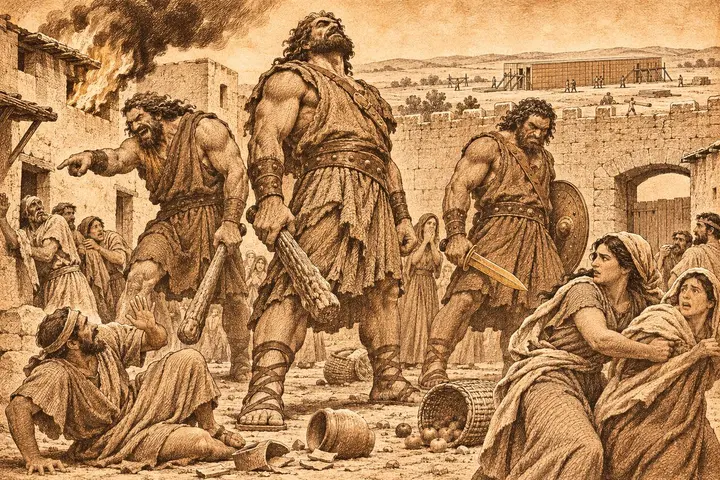 Before the floodWhy the flood came, as the Bible tells it.
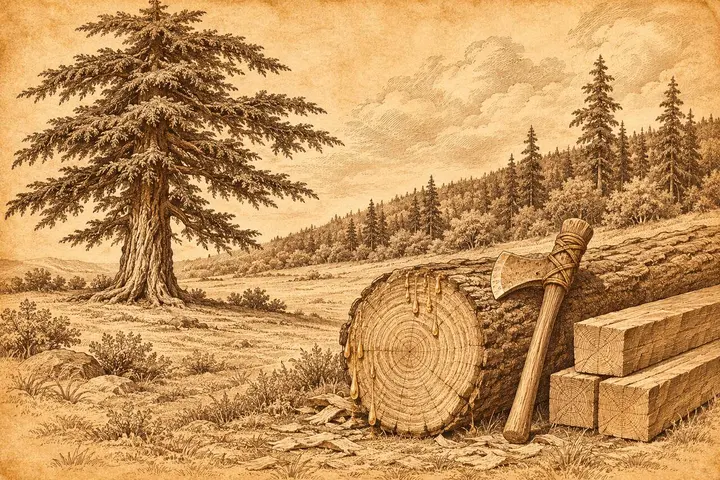
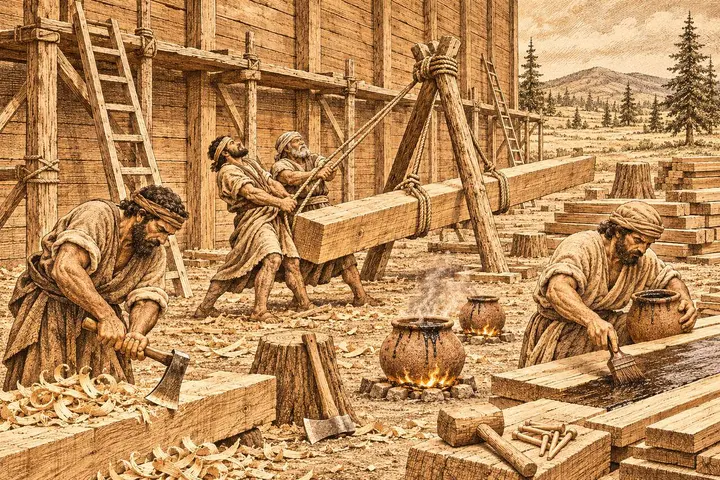 Building the arkWhat Genesis says about how the ark was made, and what it leaves unsaid.
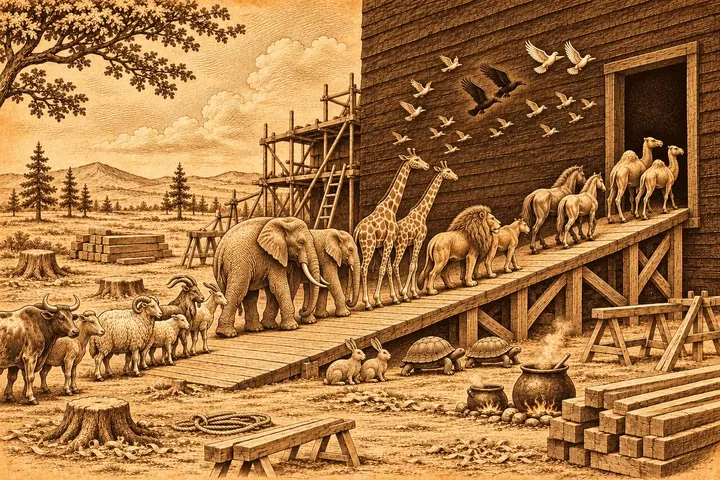 The animals and the familyWho and what went through the door before Jehovah shut it.
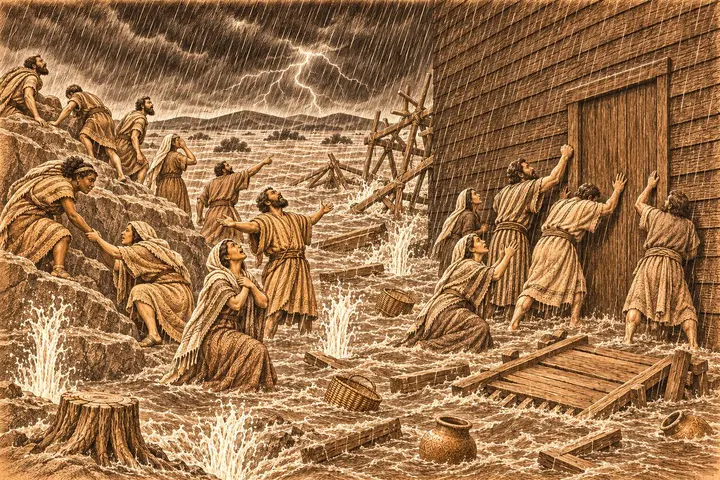 The floodThe waters, the year inside the ark, and the promise that followed.
 The flood in other culturesPeoples far apart remember a great flood. These are human traditions, shown only for comparison with the Bible record.Durupınar and the arkA formation in eastern Turkey is often called Noah’s ark. Here is how it compares with what Genesis describes.